
How it opens
I woke my parents up at 2 a.m. to tell them I had a sore eye. That sentence does not make sense, I know. But that is exactly why it mattered.
I would never have woken them for something small. I was the kid who handled things, who did not make a fuss, who pushed through.
Twenty-three chapters
What's inside
Part 1
The pattern
How being the capable one becomes the problem
- Addicted to Approval
- Capability Became My Identity
- The Diagnosis That Should've Changed The Game
- The Only Girl on Site
- The Unspoken Rule: Don't Be a Burden
- Burnout Looks Like You
- Addison's in a Hustle World
- The Crashes That Could Have Killed Me
Part 2
The breaking point
What happens when pushing through stops working
- When Strength Stops Working
- Enter Muay Thai: Where Pressure Gets Honest
- Discipline Without Self-Punishment
- The Fight I Lost Before I Even Got in the Ring
- Calm Is a Skill, Not a Personality Trait
Part 3
The rebuild
Performing at a high level without paying for it afterwards
- Baseline Before Brilliance
- Recovery Is a Strategy, Not a Reward
- Energy Management for Real Humans
- Ambition Without Self-Abandonment
- The Nervous System Is the Business
- Relationships, Not Just Results
- Sustainable Success Feels Different
- Calm Is a Power Move
- You Don't Need to Break to Change
- The Success Hangover Ends Here
Notes and references
It isn't just my story.
The ideas here are drawn from lived experience and from established research across neuroscience, performance psychology, burnout and stress physiology. The book cites its sources.
This book is not a substitute for medical or psychological advice.
The book is where it started.
It isn't where it stops.
Everything in here is what I now coach people through privately, and what I speak about on stage.
Questions
About The Success Hangover
What is a success hangover?
It is what happens when you build a life that looks impressive but feels heavy. When achievement comes with exhaustion attached. When you reach goals but do not feel the relief you expected. When pushing harder is no longer the answer, but you do not yet know another way to operate. Most high performers are living inside it without realising.
What is The Success Hangover about?
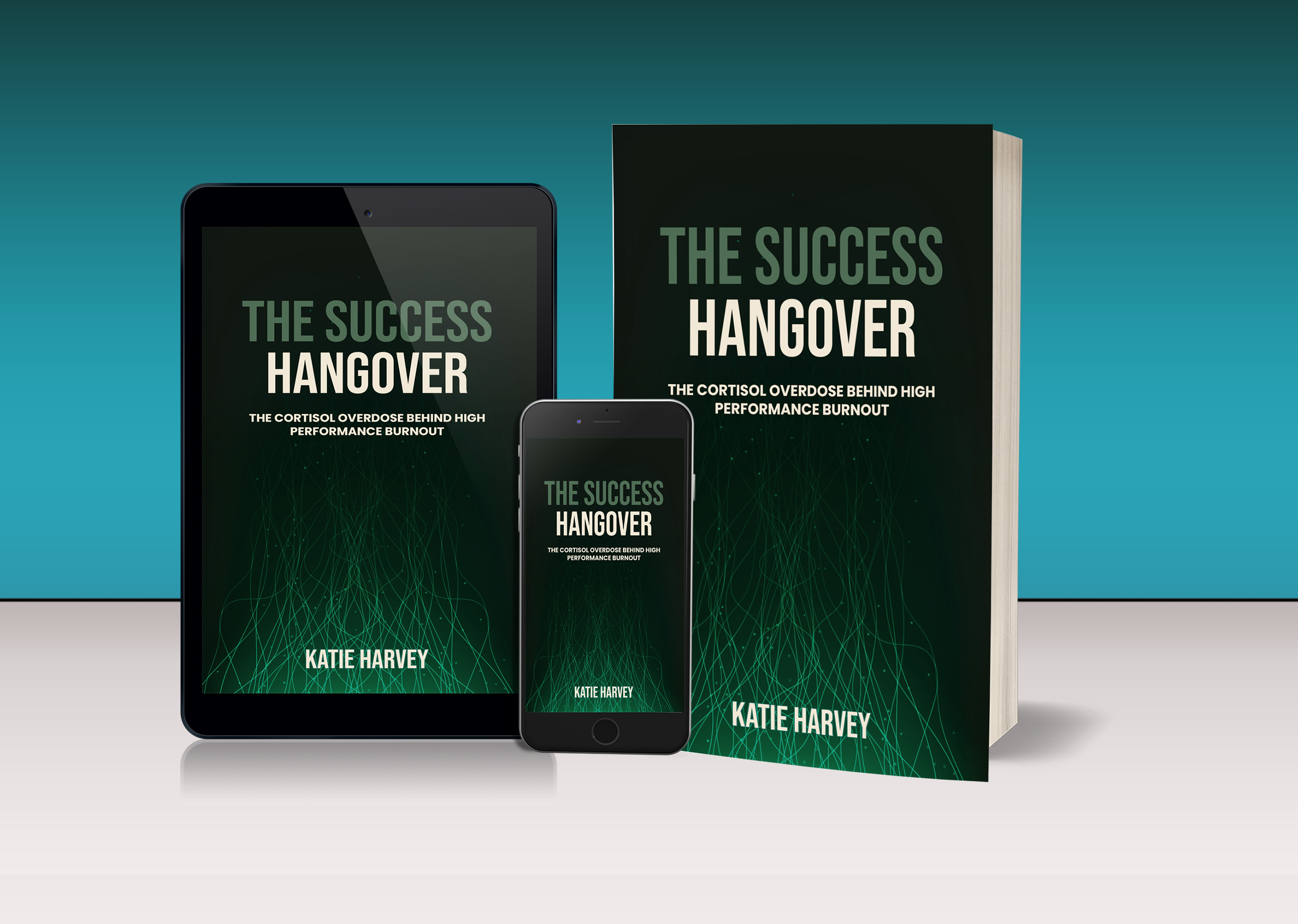
It is part memoir, part performance book and part challenge to the idea that success should require self-abandonment. Katie Harvey shares her own story alongside established research on stress, burnout and performance. It is not about how to slow down and settle. It is about how to build capacity, so you can perform at a high level and actually enjoy the life you are working so hard to create.
Who is the book for?
High performers who did everything they were told to do. They worked hard, pushed through, carried responsibility and became the person everyone depends on. From the outside it looks like success. On the inside there is a cost: the constant thinking, the inability to switch off, and the pressure that follows them even on days that are meant to be off.
What is the difference between being capable and having capacity?
Being capable is your ability to do the work. Capacity is how much you can sustainably hold. You can still be capable while your capacity drains, pouring more and more energy into maintaining what used to feel natural. When high performers struggle, the problem is rarely effort. Often they have not lost ambition. They have lost capacity.
Do I need to be burnt out to get something from it?
No. You do not need to wait for burnout, or a breaking point, to take this seriously. If you wait for a crisis to give yourself permission to change, you are probably much closer to it than you realise.
Is the book about Addison's Disease?
Katie was diagnosed with Addison's Disease at nearly seventeen, and it is part of her story because it forced her to learn a way of performing her body could actually sustain. But the book is about ambition, pressure and capacity for anyone who performs at a high level. It is not a guide to any medical condition.
What is the B.R.E.A.T.H.E framework?
The system at the back of the book: Baseline, Recovery, Energy, Alignment, Tension, Habits and Evolution. It is built on one idea: high performance is not built on pressure alone. It is built on a regulated, supported nervous system.
Where can I buy it?
On Amazon UK, in paperback and on Kindle.
Is the book medical advice?
No. It draws on lived experience and established research, and cites its sources, but it is not a substitute for medical or psychological advice.